
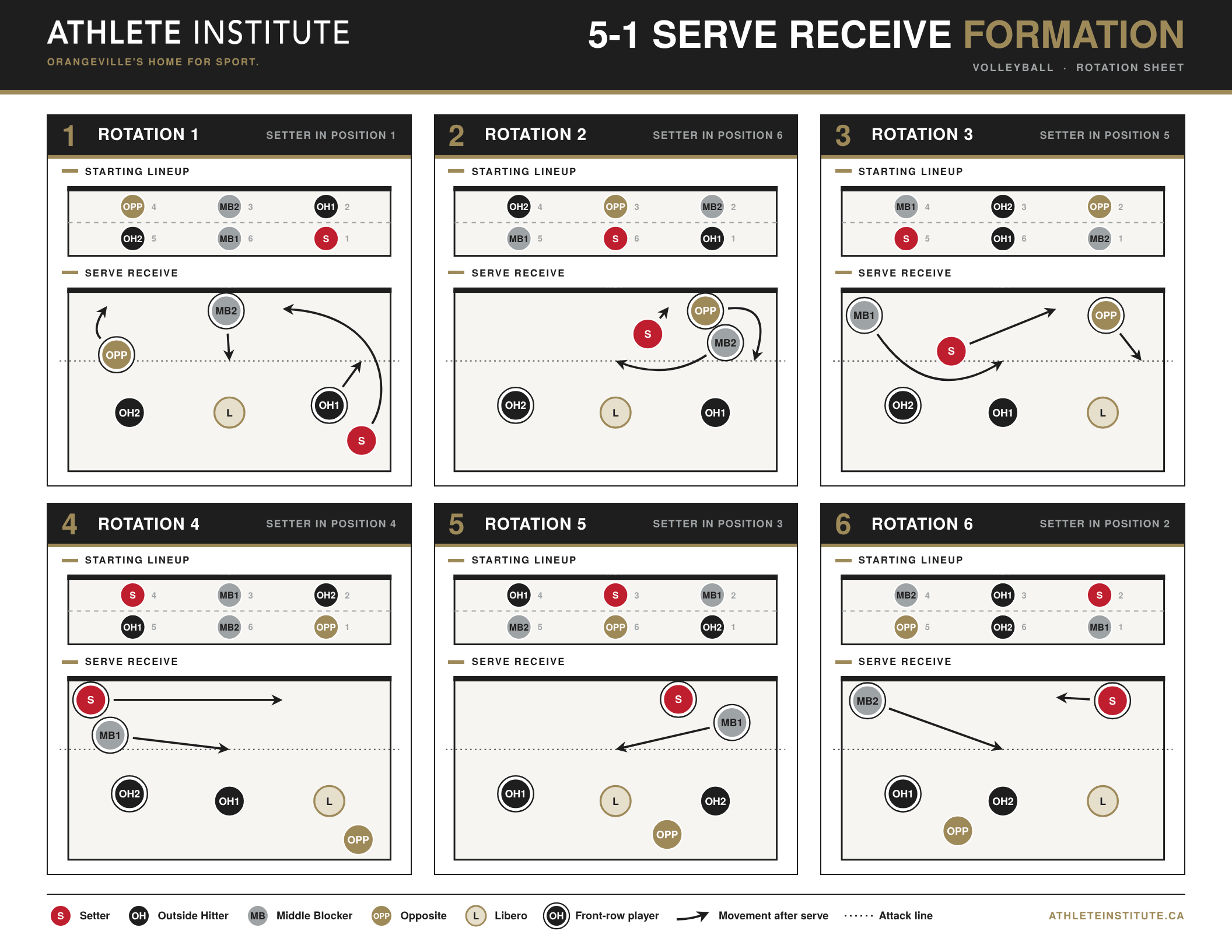
In a 5-1, one setter plays all six rotations, so the serve receive formation changes every time the team rotates. This guide walks through each rotation on the Athlete Institute sheet, one player at a time: what each player does while the serve is being received, and what they still have to do before the team settles into its initial defensive position (IDP).
Keep the sheet open as you read. Each rotation below has its own image, a short explanation of why the formation is legal, and a player-by-player breakdown you can use in practice, in a team meeting, or while watching a match.
How to Read the Sheet
Every rotation on the sheet shows two small courts, with the net at the top of each.
- Starting lineup: the legal rotation order. The front row reads 4, 3, 2 from left to right. The back row reads 5, 6, 1 from left to right.
- Serve receive: where each player actually stands when the server contacts the ball. It is a legal arrangement, but it is built to hide the setter and put three passers on the court.
- Ringed players: front-row players, even when they stand deep to pass.
- Arrows: where a player moves after the serve is contacted.
- Dotted line: the attack line.
| Label | Player | Main job |
|---|---|---|
| S | Setter | Runs the offence and always sets from position 2.5 |
| OH1OH2 | Outside hitters | Pass, then attack. The pipe option when in the back row |
| MB1MB2 | Middle blockers | Stay out of the passing lanes, then attack from the middle |
| OPP | Opposite | Hits right side from the front row (left side in rotation 1); is the C-ball option in the back row |
| L | Libero | Back-row passer who replaces the back-row middle blocker, and plays position 5 in IDP |
The Ground Rules Behind Every Formation
Every formation on the sheet is a trade-off between two things: what the rules allow, and where the team wants its players the moment the ball is passed.
The Overlap Rule
When the server contacts the ball, each team has to be in its rotation order. That order is checked in two ways:
- Front to back: each back-row player must be farther from the net than the front-row player they line up with. The pairs are 5 and 4, 6 and 3, and 1 and 2.
- Side to side: within each row, the middle player cannot be closer to a sideline than the player beside them. In the front row, 4 stays left of 3, and 3 stays left of 2. In the back row, 5 stays left of 6, and 6 stays left of 1.
A few details matter for coaching. Position is judged by where a player’s feet touch the floor, not by hands or shoulders. Diagonal neighbours are never compared, so a back-row player is only checked against the player directly in front of them. And the moment the ball is served, everyone is free to move anywhere on the court. A violation costs the team the point and the serve.
That last point is why the formations look the way they do. Players start in unusual spots that are still legal, then sprint to where they actually want to be.
Three Passers, One Setter
In serve receive, the team uses three passers: both outside hitters and the libero. They stand in a rough line across the court, each covering about a third of its width, so no serve can drift between them. The setter, the opposite and the middle blockers stay out of that line, because their jobs start after the pass.
The libero replaces whichever middle blocker is in the back row, so the libero is always one of the back-row passers.
Position 2.5
The setter does not set from position 2 or from position 3. The setter sets from position 2.5, at the net between the two. From there the setter can reach every hitter: the left side, the middle, and the right side. Every setter route on the sheet ends at that spot.
Where the Hitters Need to Be
After the pass, the front-row hitters head to their attack positions on the attack line, which is the dotted line on the sheet. The middle blocker works from the centre of the court, the right side near the right sideline, and the left side out wide on the left. A hitter who starts by standing off the net and then moves to these spots is usually far enough from the net to take a full approach.
Back-row players are attackers too, and each back-row attack has a name. A pipe is a back-row middle attack, and the outside hitters are in charge of it: when an outside hitter is in the back row, that player is the pipe option, attacking from behind the attack line through the middle of the court. A C ball is a back-row right-side attack, and it belongs to the opposite: when the opposite is in the back row, the opposite is the C-ball option, attacking from behind the attack line on the right.
What IDP Means
IDP is the initial defensive position: the base spots the team returns to once the ball has crossed the net after its attack. At the net, the left-side hitter lines up on the left, the middle blocker in the middle, and the opposite or setter on the right. In the back row, the spots belong to a position, not to a particular player:
Position 5
Deep left
Always the libero.
Position 6
Deep middle
The back-row left-side hitter, which is the outside hitter.
Position 1
Deep right
The setter or the opposite, whichever one is in the back row.
The libero and the back-right defender usually stand about 1 metre in from the sideline and 1 to 1.5 metres behind the attack line. The exact depth varies by coach and by the hitters in front of them. The libero also takes the seams on both sides, and the seam shared with the player at 6 above all, so that the outside hitter can release toward the net and be ready to attack sooner.
Each rotation below finishes with the same question: what does each player still have to do between the pass and their IDP spot?
Rotation by Rotation
Jump to any rotation, or read them in order. Each one is named for where the setter starts.
Rotation 1: Setter in Position 1
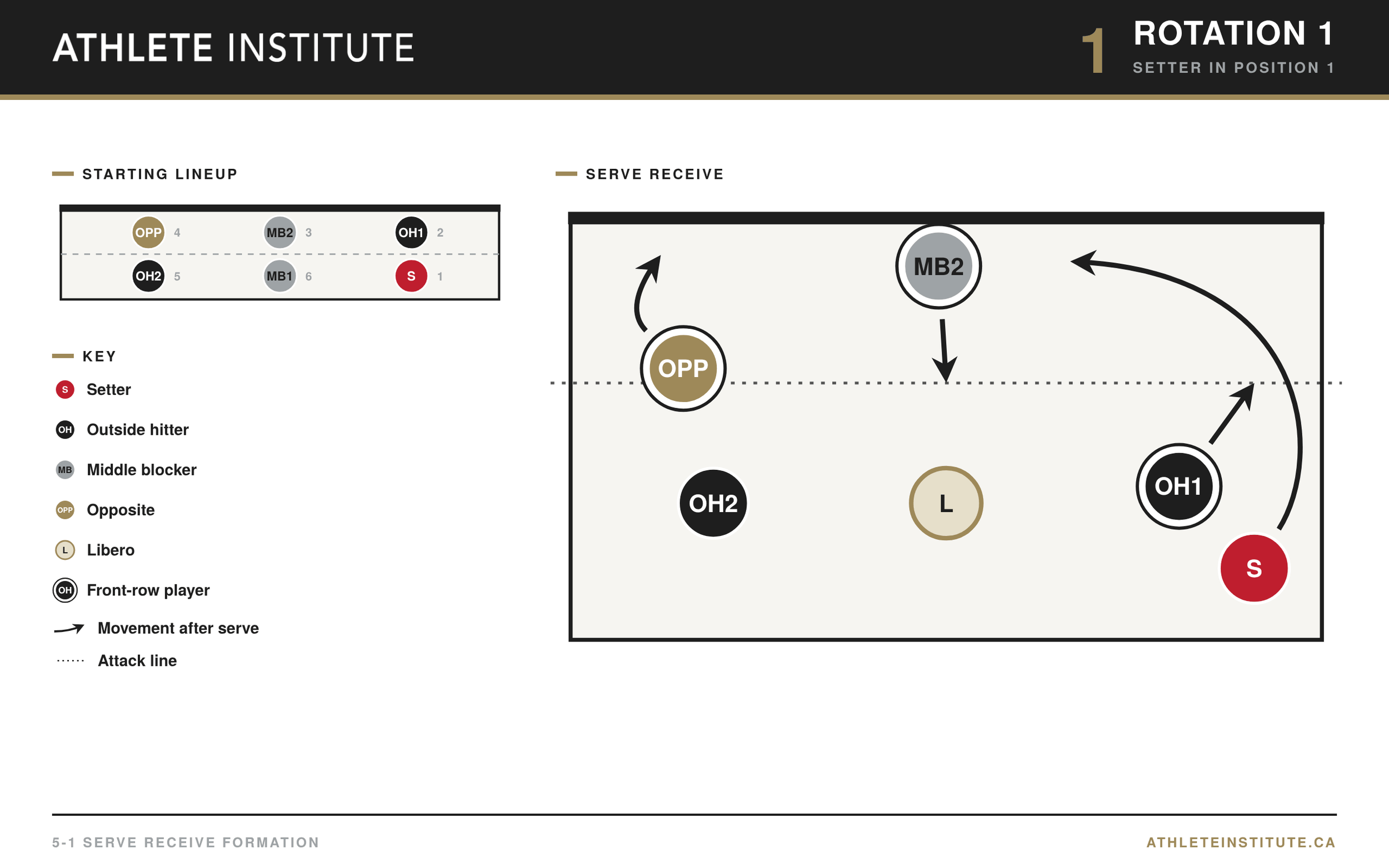
With the setter in the right-back corner, all three front-row players are hitters. The unusual part is that the opposite and the right-side outside hitter swap sides: the opposite waits on the left and hits left, while OH1 passes from the right and hits right.
The lineup is OPP at 4, MB2 at 3, and OH1 at 2 across the front, with OH2 at 5, the libero at 6, and the setter at 1 across the back. The formation is legal because the opposite is left of MB2, who is left of OH1, and the setter stands deeper than OH1 and to the right of the libero.
| Player | Serve receive role | Path to IDP |
|---|---|---|
| SPosition 1 | Stands deep in the right corner behind OH1, well out of the passing line. Does not pass. | Runs up the right sideline as soon as the serve is contacted, then slides in to position 2.5 to set. After setting, drops back to position 1 on the deep right. |
| OPPPosition 4 | Stands on the left near the attack line, out of the passing line. Does not pass. | Moves forward to the net and out wide on the left to approach as the left-side hitter. After the swing, travels across to right front for IDP. |
| MB2Position 3 | Stays tight to the net in the middle of the court, out of every passing lane. Does not pass. | Steps off the net after the serve is contacted and gets to the middle of the attack line, ready to hit. After the swing, closes to the middle for IDP. |
| OH1Position 2 | Passes the right third of the court, even though standing in the front row. | After passing, moves up to the right side of the attack line and approaches as the right-side hitting option for the first ball. After the swing, travels across to left front for IDP. |
| OH2Position 5 | Passes the left third of the court. | After passing, moves in to the deep-middle spot (position 6) as the pipe option, then holds there for IDP. |
| LPosition 6 | Passes the middle third, taking the seam balls on both sides. | After passing, slides left to the deep-left spot (position 5) and takes the seams on both sides of OH2. |
What to rehearseThe setter's timing. The run up the sideline is long, so the setter leaves on the serve contact, not on the pass. Passers aim for position 2.5, not for wherever the setter happens to be.
Rotation 2: Setter in Position 6
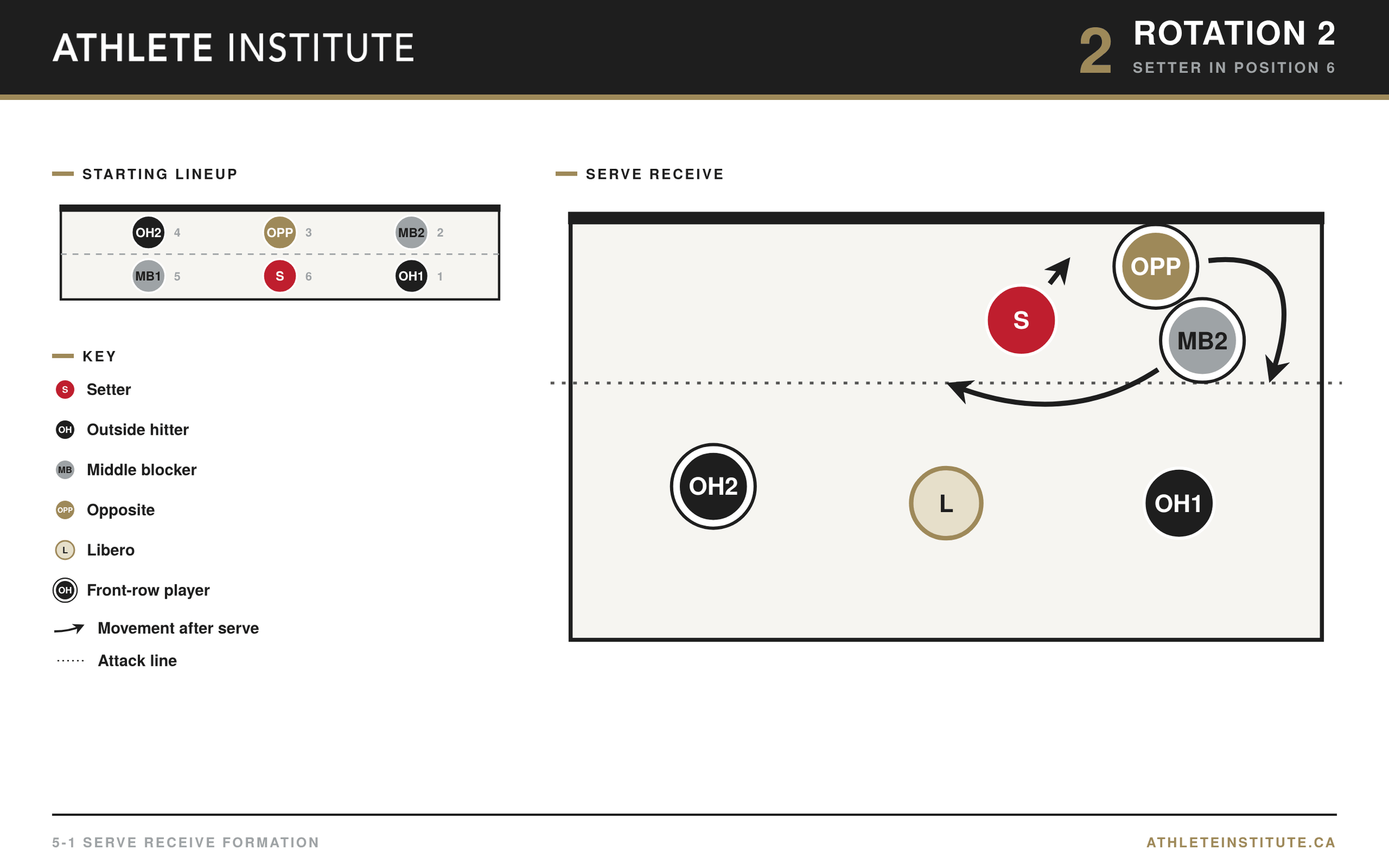
The setter starts in the middle of the back row, only a short step from position 2.5, so the setter's route is one of the shortest on the sheet. The front row bunches the opposite and MB2 on the right side of the net and leaves OH2 alone on the left, which opens up the court for the three passers.
The lineup is OH2 at 4, OPP at 3, and MB2 at 2 across the front, with the libero at 5, the setter at 6, and OH1 at 1 across the back. It is legal because OH2 is left of the opposite, who is left of MB2; the libero is left of the setter, who is left of OH1; and each back-row player stands deeper than the front-row player in front of them.
| Player | Serve receive role | Path to IDP |
|---|---|---|
| SPosition 6 | Tucks in just behind the opposite, a few feet off the net. Does not pass. | Takes a short step forward and to the right into position 2.5 as the serve is contacted. After setting, drops back to position 1 on the deep right. |
| OPPPosition 3 | Stands at the net just right of centre, out of the passing line. Does not pass. | Slides out toward the right sideline, then turns to the attack line to approach as the right-side hitter. Already on the right, so IDP is right front. |
| MB2Position 2 | Stands on the right a few feet off the net, beside the opposite. Does not pass. | Swings inside and slightly back, staying clear of the setter's route, then drives to the middle of the attack line. After the swing, closes to the middle for IDP. |
| OH2Position 4 | Passes the left third of the court from the front row. | Steps up to the left side of the attack line and approaches as the left-side hitter. Left front is already the IDP spot. |
| LPosition 5 | Passes the middle third, taking the seam balls on both sides. | After passing, slides left to the deep-left spot (position 5) and takes the seams on both sides of the outside hitter at 6. |
| OH1Position 1 | Passes the right third of the court. | After passing, moves in to the deep-middle spot (position 6) as the pipe option, then holds there for IDP. |
What to rehearseThe crossover between MB2 and the setter. The setter's route is short, so the setter goes first and MB2 loops in behind to arrive at the middle of the attack line.
Rotation 3: Setter in Position 5
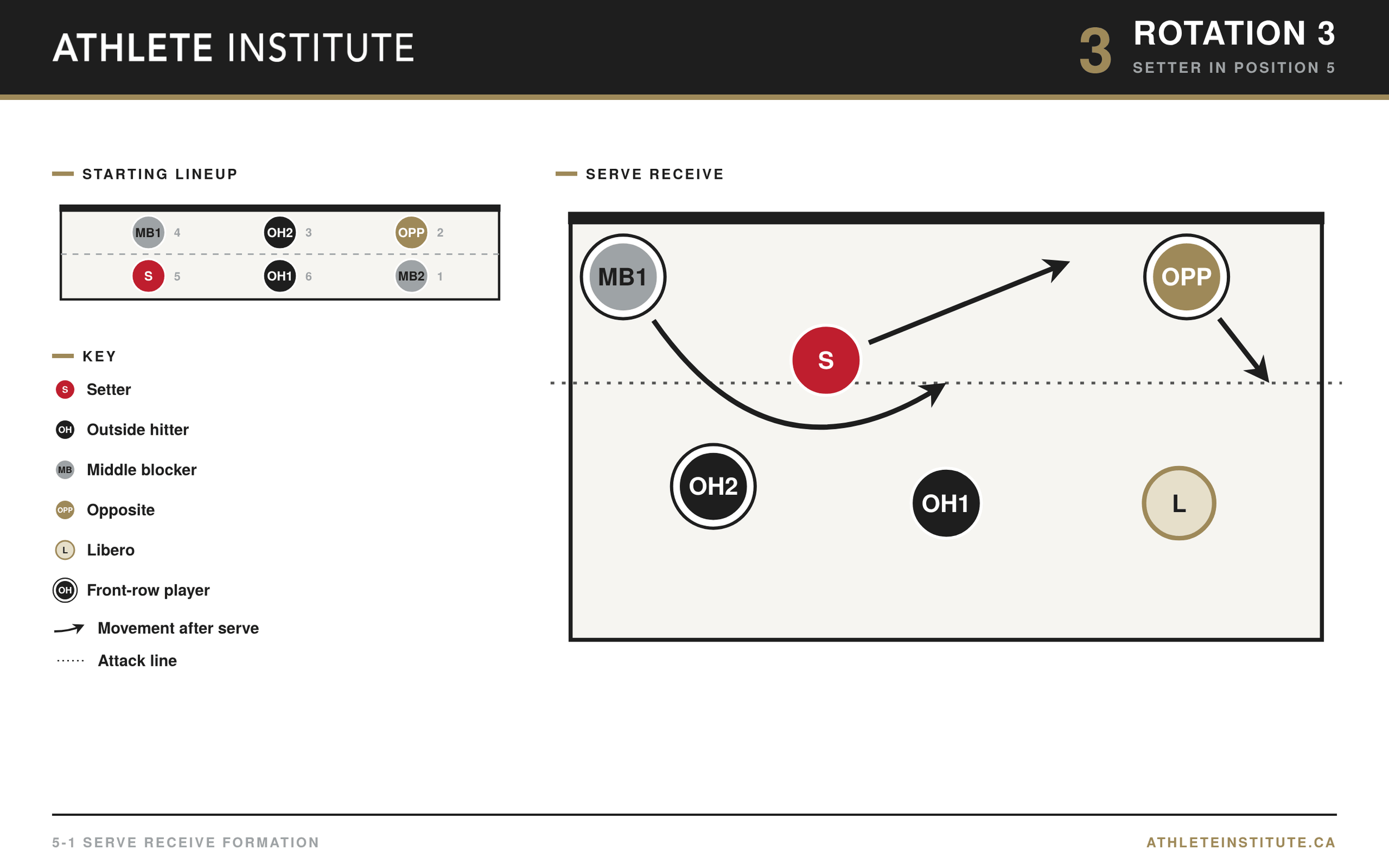
The setter starts on the left side of the back row and has to cross the court on a diagonal to reach position 2.5. Both the setter and the left-side middle blocker travel a long way, so this rotation is about leaving early and not colliding. Like rotation 1, it has three front-row hitters.
The lineup is MB1 at 4, OH2 at 3, and OPP at 2 across the front, with the setter at 5, OH1 at 6, and the libero at 1 across the back. It is legal because MB1 is left of OH2, who is left of the opposite; the setter is left of OH1, who is left of the libero; and each back-row player stands deeper than the front-row player in front of them.
| Player | Serve receive role | Path to IDP |
|---|---|---|
| SPosition 5 | Stands left of centre, a few feet off the net, in front of the passing line. Does not pass. | Runs diagonally forward and to the right across the front of the passers to position 2.5. After setting, drops back to position 1 on the deep right. |
| MB1Position 4 | Stands on the far left at the net, away from every passing lane. Does not pass. | Has one of the longest trips of any middle: curves back and around the passers, then drives forward to the middle of the attack line. After the swing, closes to the middle for IDP. |
| OH2Position 3 | Passes the left third of the court, even though listed in the front row. | Steps up to the left side of the attack line and approaches as the left-side hitter. Left front is already the IDP spot. |
| OH1Position 6 | Passes the middle third and takes the seam balls on both sides. | Already in the deep-middle spot (position 6). Stays there as the pipe option, then holds for IDP. |
| LPosition 1 | Passes the right third of the court. | After passing, travels across to the deep-left spot (position 5) and takes the seams on both sides of OH1. |
| OPPPosition 2 | Hugs the net on the right, out of the passing line. Does not pass. | Steps off the net after the serve is contacted and gets to the right side of the attack line, so there is room for a full approach. After the swing, stays on the right for IDP. |
What to rehearseWho goes where on the crossing routes. The setter goes in front of the passers on the diagonal, and MB1 goes around behind, so the two never run into each other.
Rotation 4: Setter in Position 4
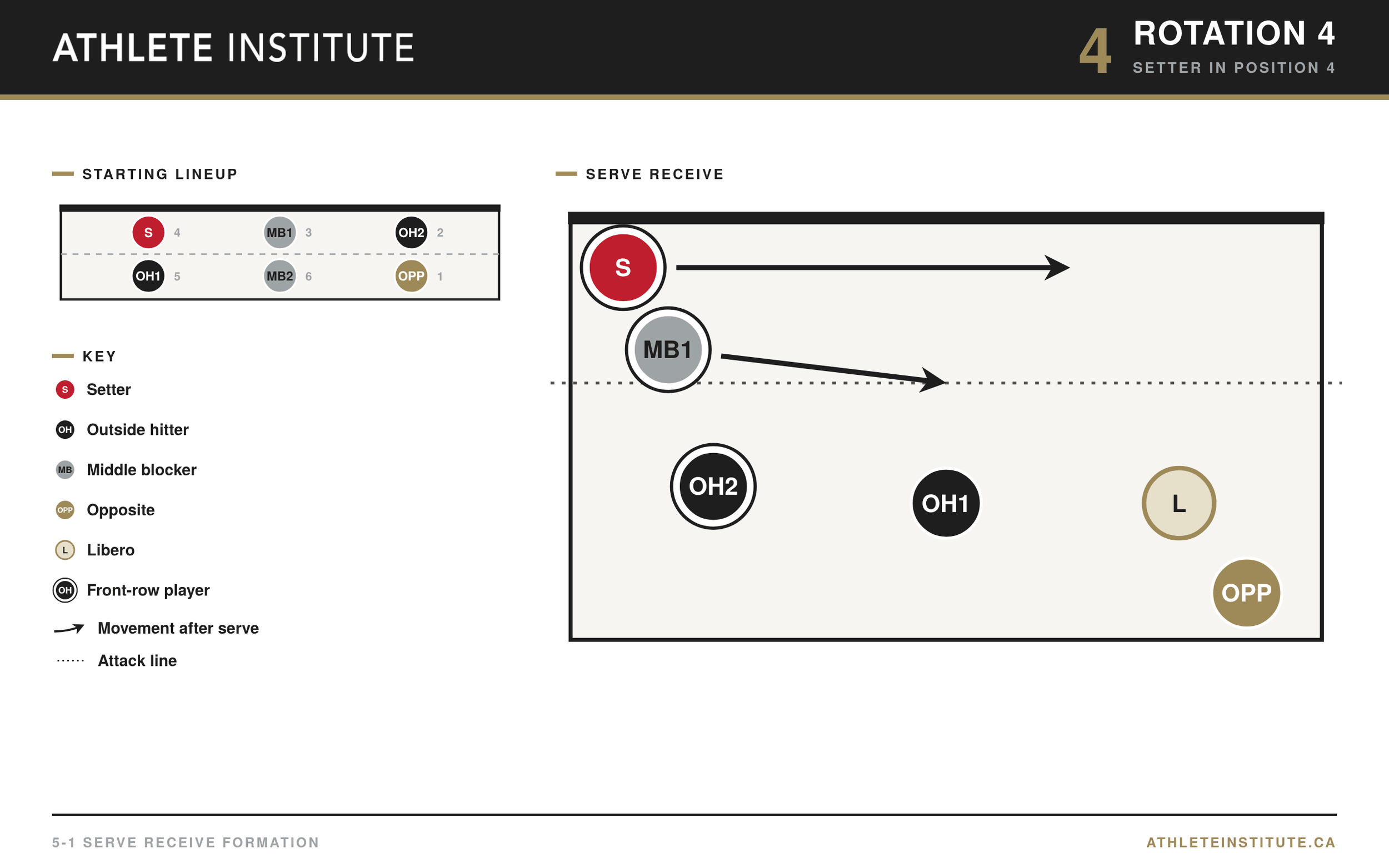
The setter is now in the front row, which means the team has only two front-row hitters, OH2 and MB1. The setter starts on the far left of the net, hidden in the corner, and the opposite hides in the deep right corner. This is the rotation where the left-side players are packed closest together, so legal positioning takes the most care.
The lineup is S at 4, MB1 at 3, and OH2 at 2 across the front, with OH1 at 5, the libero at 6, and the opposite at 1 across the back. The setter has to be left of MB1, and MB1 has to be left of OH2, even though OH2 stands wide on the left as the lead passer. In the back row, OH1 is left of the libero, who is left of the opposite, and every back-row player stands deeper than the front-row player in front of them.
| Player | Serve receive role | Path to IDP |
|---|---|---|
| SPosition 4 | Stands on the far left at the net, to the left of MB1. Does not pass. | Slides along the net to position 2.5, the longest slide along the net of any rotation. After setting, moves to right front as a blocker for IDP. |
| MB1Position 3 | Stands just right of the setter and a few feet off the net, which keeps the setter's route along the net clear. Does not pass. | Makes a short shift right to the middle of the attack line. After the swing, closes to the middle for IDP. |
| OH2Position 2 | Lined up at 2 but passes the left third, standing just right of MB1. | Steps up to the left side of the attack line and approaches as the left-side hitter. Left front is the IDP spot. |
| OH1Position 5 | Passes the middle third and takes the seam balls on both sides. | Moves in to the deep-middle spot (position 6) as the pipe option, then holds there for IDP. |
| LPosition 6 | Passes the right third of the court. | After passing, travels across to the deep-left spot (position 5) and takes the seams on both sides of OH1. |
| OPPPosition 1 | Stands in the deep right corner behind the libero. Does not pass. | With no right-side hitter in the front row, the opposite is the C-ball option. Position 1 is the IDP spot, and the opposite is already there. |
What to rehearseChecking neighbours before the serve. The setter, MB1 and OH2 all start within a few feet of one another, and being a few inches out of order is an overlap.
Rotation 5: Setter in Position 3
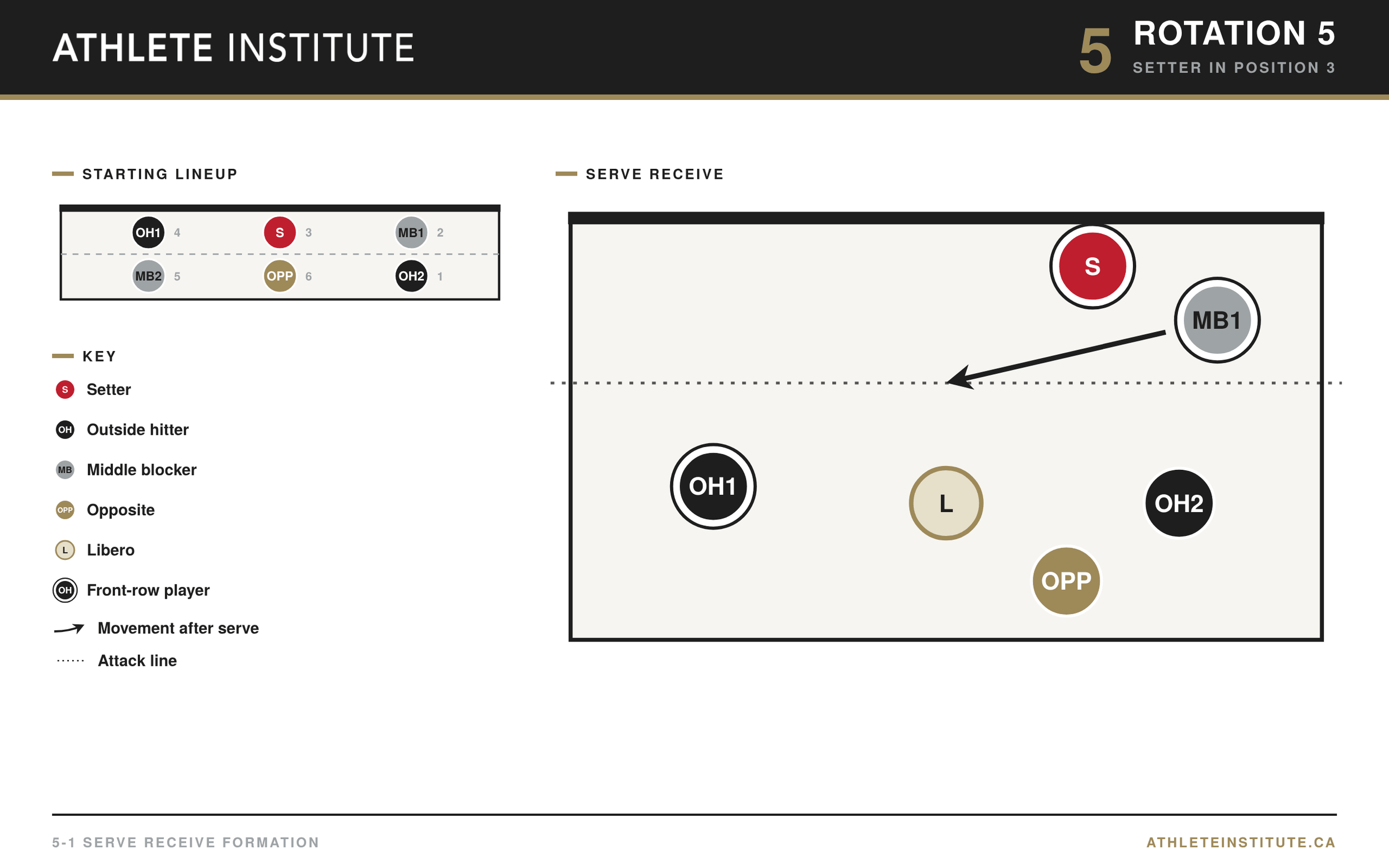
The setter starts at the net almost exactly where the setter needs to be, so this is the shortest setter route on the sheet. With the setter in the front row there are again only two front-row hitters, OH1 and MB1, and the opposite hides deep in the middle of the back row.
The lineup is OH1 at 4, S at 3, and MB1 at 2 across the front, with the libero at 5, the opposite at 6, and OH2 at 1 across the back. It is legal because OH1 is left of the setter, who is left of MB1; the libero is left of the opposite, who is left of OH2; and each back-row player stands deeper than the front-row player in front of them.
| Player | Serve receive role | Path to IDP |
|---|---|---|
| SPosition 3 | Stands at the net just left of MB1, already close to position 2.5. Does not pass. | Makes a small slide to the right into 2.5 when the serve is contacted. After setting, moves to right front as a blocker for IDP. |
| MB1Position 2 | Stands on the far right, a few feet off the net, to the right of the setter. Does not pass. | Cuts left across the court behind the setter to the middle of the attack line. After the swing, closes to the middle for IDP. |
| OH1Position 4 | Passes the left third of the court from the front row. | Steps up to the left side of the attack line and approaches as the left-side hitter. Left front is already the IDP spot. |
| LPosition 5 | Passes the middle third, taking the seam balls on both sides. | After passing, slides left to the deep-left spot (position 5) and takes the seams on both sides of OH2. |
| OPPPosition 6 | Hides deep behind the setter, a little right of centre. Does not pass. | With no right-side hitter in the front row, the opposite is the C-ball option. Slides to position 1 on the deep right for IDP. |
| OH2Position 1 | Passes the right third of the court. | After passing, moves in to the deep-middle spot (position 6) as the pipe option, then holds there for IDP. |
What to rehearseMB1's cut behind the setter. The setter is already at the net, so MB1 has to arrive at the middle of the attack line from behind and leave the setter's lane open.
Rotation 6: Setter in Position 2
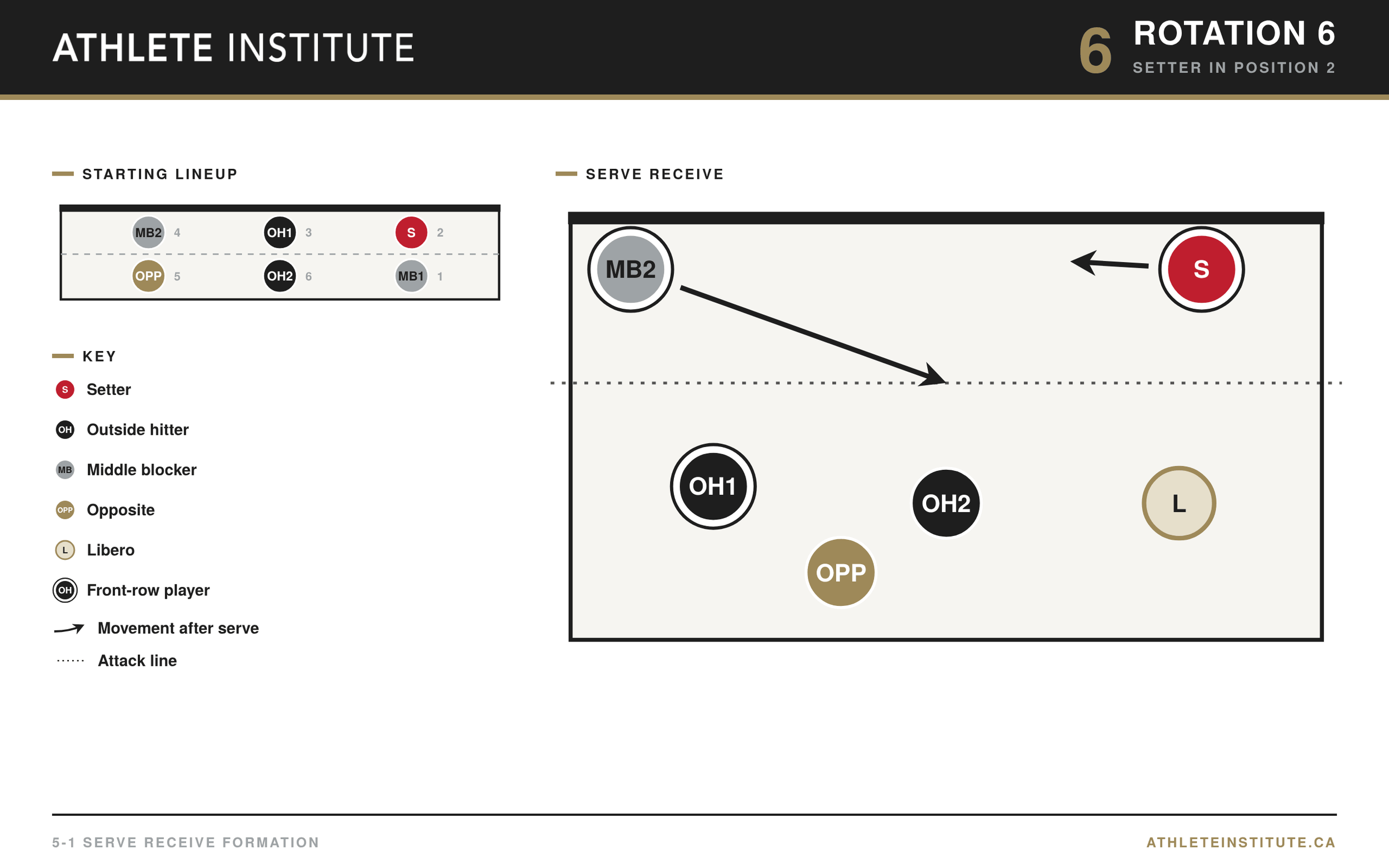
The setter is at the right side of the net, a short slide from position 2.5. The front row has two hitters, MB2 and OH1, and the opposite starts as far from the action as the rules allow, deep on the left side of the back row. The cost is a long trip afterwards, because the opposite finishes on the opposite side of the court.
The lineup is MB2 at 4, OH1 at 3, and S at 2 across the front, with the opposite at 5, OH2 at 6, and the libero at 1 across the back. It is legal because MB2 is left of OH1, who is left of the setter; the opposite is left of OH2, who is left of the libero; and each back-row player stands deeper than the front-row player in front of them.
| Player | Serve receive role | Path to IDP |
|---|---|---|
| SPosition 2 | Stands at the net on the far right. Does not pass. | Makes a short slide left along the net to position 2.5. After setting, stays on the right for right front as a blocker in IDP. |
| MB2Position 4 | Stands on the far left at the net, away from every passing lane. Does not pass. | Steps off the net and drives diagonally across to the middle of the attack line. After the swing, closes to the middle for IDP. |
| OH1Position 3 | Passes the left third of the court, even though listed in the front row. | Steps up to the left side of the attack line and approaches as the left-side hitter. Left front is already the IDP spot. |
| OPPPosition 5 | Hides deep on the left side of the back row. Does not pass. | After the pass, travels all the way across the back of the court to position 1 on the deep right, where the opposite is the C-ball option. Holds there for IDP. |
| OH2Position 6 | Passes the middle third and takes the seam balls on both sides. | Already in the deep-middle spot (position 6). Stays there as the pipe option, then holds for IDP. |
| LPosition 1 | Passes the right third of the court. | After passing, travels across to the deep-left spot (position 5) and takes the seams on both sides of OH2. |
What to rehearseThe crossover at the back between the libero and the opposite. They travel in opposite directions along the baseline, so they need to call and pass behind each other, with the player closer to the ball going first.
Putting It All Together
Six rotations look like a lot to remember, but they follow two patterns.
Rotations 1, 2 and 3
Setter in the back row
Three front-row hitters are ready to attack, with the back-row outside hitter as the pipe option. The setter runs to position 2.5, and the middle and the hitters adjust around that route.
Rotations 4, 5 and 6
Setter in the front row
Only two front-row hitters, so the back-row attack comes from the pipe option and from the opposite, who is the C-ball option. The setter finishes at the net and becomes a blocker.
In every rotation the same three players pass: OH1, OH2 and the libero, spread evenly across the court. The setter, the opposite and the middle blockers stay out of their way, then get to work the moment the serve is contacted.
A few cues apply to every rotation:
- Be legal first, then move. Positions are judged at the moment of serve contact, so check your neighbours before the serve and go only after contact.
- Pass to position 2.5. The target is the spot the setter is heading to, not the setter.
- Move early. The setter, the middles and the opposite all have a long way to go in some rotations, so they leave on the serve, not on the pass.
- Cross behind, not through. When two players cross, the one with the shorter route goes first, and the other loops behind.
- Finish in IDP. Every attack ends with a return to base. At the net it is left, middle and right. In the back row it is the libero at 5, the left-side hitter at 6, and the setter or opposite at 1.
- Libero takes the seams. The libero covers the seams on both sides, and the one shared with the player at 6 above all, so the left-side hitter can release and attack sooner.
Always check your league’s current rulebook for how overlap is enforced.
Frequently Asked Questions
A 5-1 is an offence with one setter and five attackers: two outside hitters, two middle blockers, and one opposite. The same setter sets in all six rotations, whether in the front row or the back row. The libero replaces whichever middle blocker is in the back row.
When the server contacts the ball, each back-row player must be farther from the net than the front-row player they line up with (positions 5 and 4, 6 and 3, 1 and 2). Within each row, players must also stay in left-to-right order. Position is judged by where a player's feet touch the floor, and everyone is free to move once the ball is served.
The formation is a legal arrangement that does two jobs at once: it spreads three passers evenly across the court, and it tucks the setter, opposite and middle blockers out of the passing lanes. Once the ball is served, everyone sprints to where they actually want to be.
The two outside hitters and the libero pass, spread in an even line so each covers about a third of the court. The setter, opposite and middle blockers stay out of the passing line and get ready to set or attack.
IDP is the initial defensive position: the base spots a team returns to after the ball crosses the net on its attack. In the back row, the libero plays position 5 (deep left), the back-row left-side hitter plays position 6 (deep middle), and the setter or opposite plays position 1 (deep right).
A pipe is a back-row middle attack, and the outside hitters are in charge of it. A C ball is a back-row right-side attack, and it belongs to the opposite whenever the opposite is in the back row.
The libero plays position 5, usually about 1 metre in from the sideline and 1 to 1.5 metres behind the attack line, though the exact depth varies by coach and by the hitters in front. In most situations the libero takes the seams on both sides, and the seam shared with the player at 6 above all, so the left-side hitter can release and be ready to attack sooner.
Train Volleyball at Athlete Institute
Explore volleyball camps and programs at our campus in Mono, Ontario, just outside Orangeville.
Explore Volleyball CampsQuestions? Call 519.940.3735 or email info@athleteinstitute.ca